Cutting costs will not be enough: prioritise cash flow
To improve their chances of surviving the Great Lockdown, SME leaders will need to anticipate the risk of a cash crisis. During the restart of activity, the descent into and passage through the depression, and then the rebound, many companies will die from a lack of liquidity even though they had cut costs and their competitiveness did not appear to be at risk. Here is our advice on how better to prevent a fatal cash accident.
Forecast cash flow and financial flows
When the road becomes very slippery, looking further ahead to anticipate a skid saves your life. Update your 3-month cash flow forecasts and financing tables (Fig. 1) more frequently to analyse variances against your forecasts and identify risk areas. When the fall in cash flow (EBITDA minus the change in working capital requirement) stems from operating losses, it is important to analyse the cause in order to decide which measures to take: change of business model, restructuring, sales initiatives, etc.
Act on revenue
Weigh your cash requirements against your revenue opportunities, particularly for question-mark products and loss leaders (2). In a crisis, you also need to be prepared to walk away from a deal with a customer of uncertain creditworthiness or from a market that is costly in terms of sales investment.
Do not let your sales staff lose motivation because of an outdated pay scheme: adapt targets to the level of activity and pay commission more frequently.
Optimise the operating cycle
Mobilise all your employees to shorten the production cycle and the time between taking an order and receiving payment. Reduce stock by cutting the number of product lines and accepting the risk of stock-outs on slow sellers. Negotiate, without abusing your position, with your least vulnerable suppliers.
Cut unnecessary spending
Resize without delay, but not before calculating the payback on restructuring costs, considering the alternatives and assessing what and whom you will need in order to bounce back more strongly.
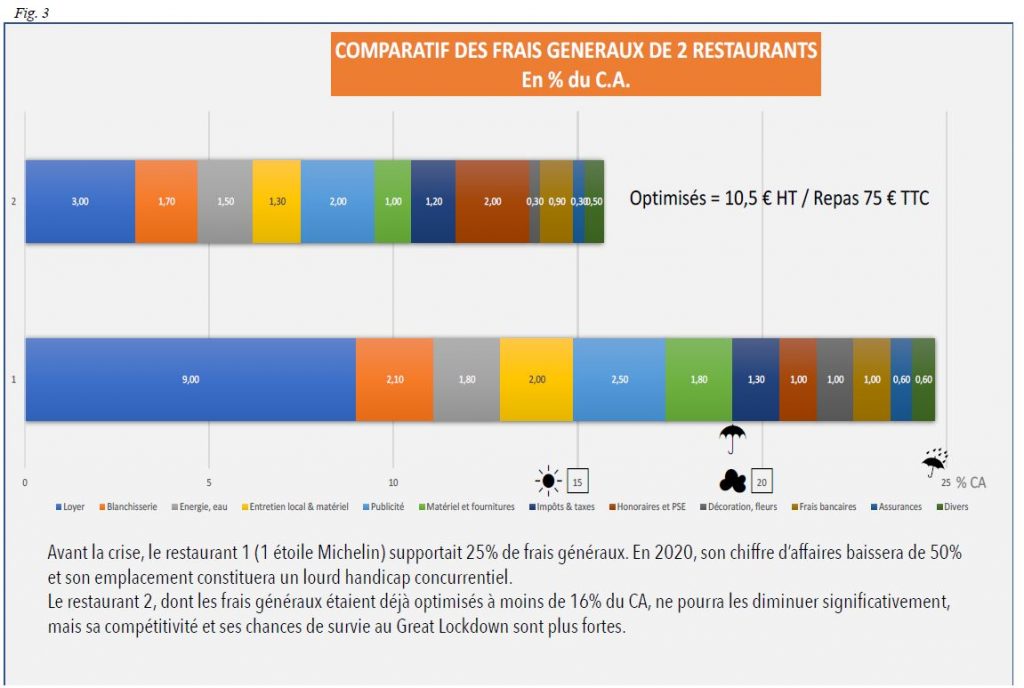
Before slashing overheads, analyse them: stopping advertising will not save you if your rent now represents 20% or 30% of revenue, compared with 9% before the crisis (Fig. 3). Buy only what you need to produce and to help you survive.

If the situation calls for pay cuts, senior management and managers must lead by example. Provide for a catch-up as soon as business recovers. Have your payroll calculations checked by an expert paid on results.
Reconsider investment
Cancel any investment that does not contribute to the company’s short-term survival and consider opportunities to divest: asset disposals, sale and leaseback.
Broaden your sources of finance
If you have taken out a state-guaranteed bank loan, you know that it will have to be repaid out of your future cash flows. At this early stage of the Great Lockdown crisis, the first casualties are companies that are over-indebted or undercapitalised relative to their exposure to successive economic shocks. Before considering applying for new credit lines, any business that is viable in the long term should seek to increase its equity and its safety margin, working capital.
In our view, turning to employee share ownership can meet this objective in many SMEs (SA or SAS companies). It is also the recurring form of finance most closely linked to your cash flow, provided it is built into your share-based profit-sharing policy: free share awards, employer matching contributions on the profit-sharing (incentive) scheme and statutory profit-sharing (participation) invested in your company’s shares through the Company Savings Plan (PEE), and capital increases reserved for employees with social security and tax advantages.
By involving all your employees in this way, rather than, for example, just the Finance Director, in your long-term survival and in your revenue, cost control, stock reduction and lead-time targets, what do you have to lose?
While in a large company employee shareholders are motivated by the prospect of a sound investment, the benefits of this policy in an SME are first and foremost greater commitment to performance or to implementing your strategy, a stronger sense of belonging and recognition, leading in turn to better retention.
For the principal shareholder of an SME, the time to choose between risking dying alone and surviving together may well have come.