Having looked, in the articles published on 30 April and 3 May 2018, at ways to ‘flatten’ overheads and ‘push up’ gross margin, let us now turn to the final part of our recipe for increasing a restaurant’s value added (VA) and profitability.
3/ ‘Seasoning’ pay according to wealth creation
The influence of a restaurant’s two brigades on profitability can be maximised by dressing existing salaries with an ingredient that brings out their flavour – provided it is based on wealth creation.
What is at stake in the pay of cooks and waiting staff
A restaurant’s current economic and social performance may be held back by:
- High staff turnover: except in groups that deliberately plan for high staff rotation to keep the payroll down, turnover is a handicap because it curbs performance and generates inefficiency costs;
- Recruitment difficulties linked to the arduous nature of the work, the working hours or the employer’s lack of appeal;
- Pay structure: with 100% fixed pay for a waiter or cook, motivation to deliver results rests solely on non-monetary management tools;
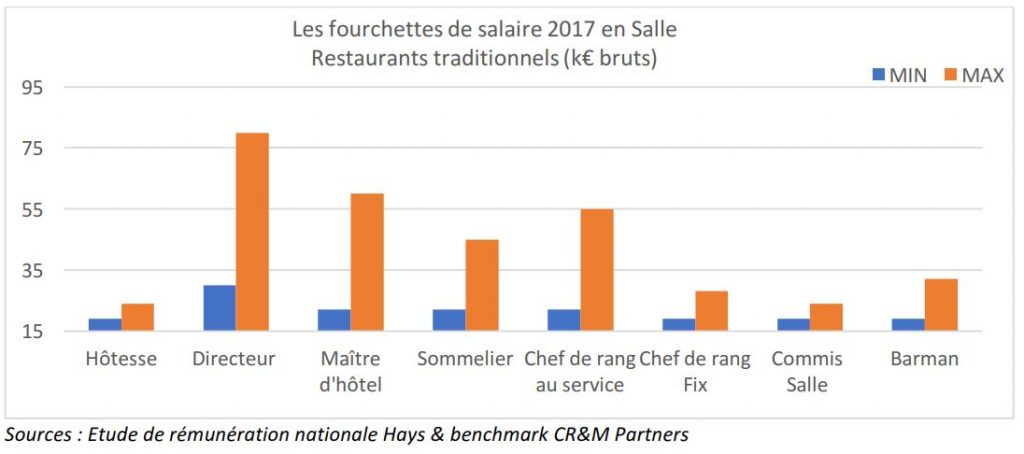
- Competitiveness of pay: according to the 2017 Hays sector survey, the salary range for a Chef de rang runs from €19k (under 3 years’ service) to €28k (over 8 years) gross per year, and that of a Restaurant Manager from €30k to €54k. However, establishments – mainly in Paris – that pay front-of-house staff a percentage of turnover including service charge (11.5% to 15%) can, in good years, offer their best waiting staff salaries twice as high as restaurants paying a fixed salary. In a large brasserie or a renowned restaurant, the Manager can expect a salary of €60k to €90k depending on headcount and turnover.
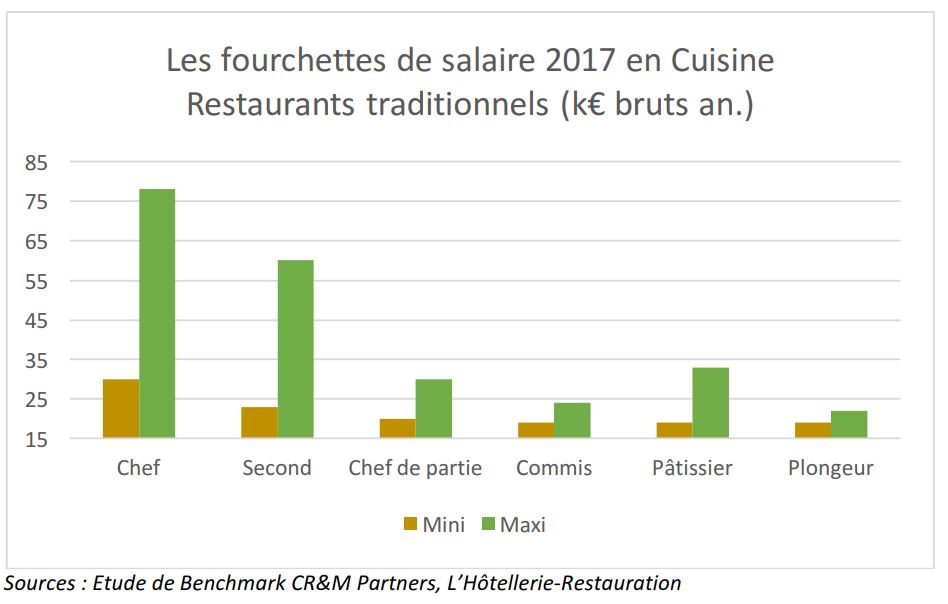
- Lack of pay equity: the salaries of Cooks, Chefs de partie, Pastry Chefs and Commis, who benefit neither from tips nor from service-charge pay, are sometimes well below those of their colleagues in the front-of-house brigade, despite their work being more arduous.
To ease these obstacles to performance, should you raise salaries or other forms of pay?
Both front of house and in the kitchen, the largest age group is employees under 30, whose pay needs centre on purchasing power rather than on retirement or savings. But offering purchasing power through above-market salaries is only conceivable with profitability significantly better than that of your competitors, or by setting aside the profit objective altogether.
Even in restaurants that pay a share of the service charge or offer bonuses to their Managers, the aim of improving or maintaining profitability calls for a specific pay arrangement that gives every employee a stake in its success, because each employee’s influence counts in a trade where performance is above all collective. A profit-sharing (incentive) scheme is better suited than salary to achieving this, because it corresponds to the Performance Salary Cost (PSC) mentioned previously and below.
Only 7.3% of employees in the highly fragmented Accommodation and Food Services sector were covered by a profit-sharing (intéressement) agreement in 2015, whereas the all-sector average stands at 36%. With the abolition of the forfait social (employer levy) on profit-sharing, there is therefore a real competitive advantage to be gained by giving employees a stake in improving the restaurant’s performance through this scheme.
Why fund the profit-sharing scheme from wealth creation?
From an economic standpoint, focusing on wealth creation and increasing VA is more beneficial than a view centred on prime cost or on pre-tax profit. It means that:
- The team’s know-how and work will tend to be better valued, both by customers and in the profit and loss account;
- The potential offered by investments can be better exploited by employees who are valued professionally and financially;
- Profit-sharing will depend as little as possible on factors employees cannot influence.
The economic productivity of labour is measured by the ratio Staff costs / VA, which is decisive for the rate of profitability: at 90% you are in danger, and at 70% the result will be very good in this sector, with gross operating profit then approaching 30% of the wealth created. With a given staff cost structure, the objective is therefore to produce more VA.
From a social point of view, the greater the VA and productivity, the bigger the ‘cake’ to share. By improving staff productivity, you have more room for manoeuvre to increase the pay of your managers and employees without detriment to the owner’s. Provided, that is, you favour PSC (Performance Salary Cost – see the article of 24 April 2018, ‘What profitability are you aiming for?’), self-financed by wealth creation.
In France, PSC in the form of a differentiated profit-sharing scheme is the most cost-effective solution, with an efficiency rate of 92% in 2019, compared with 57% to 60% for an individual bonus or salary (arrangements which are, moreover, generally less motivating than the former).
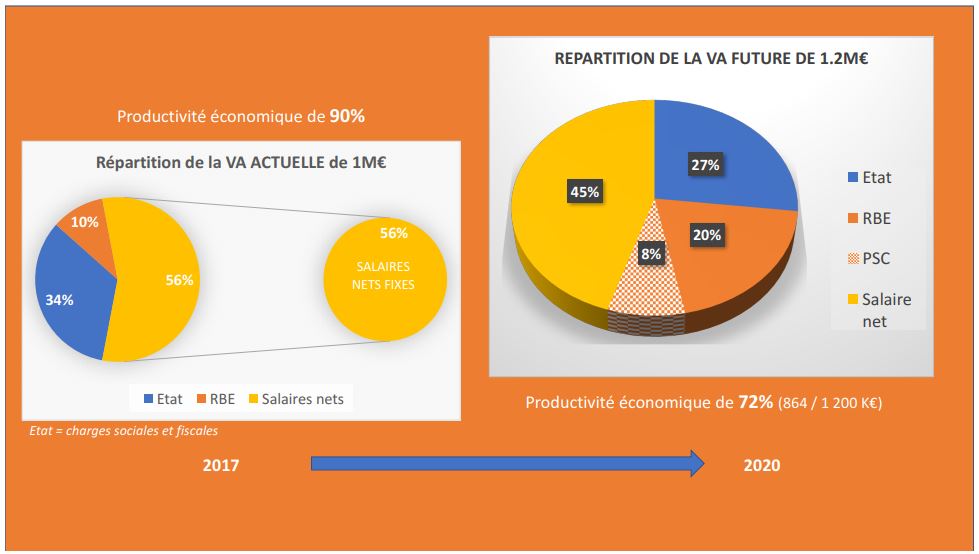
French-style PSC, combined with appropriate management, generates considerable leverage: in the example below, a 20% increase in value added achieved over 3 years goes hand in hand with:
- 100% growth in the profit rate, which rises from 10% to 20% of VA;
- Gross economic productivity of labour of 72%, and 80% net, instead of 90%;
- A profit-sharing payment equivalent to 2 months’ salary, an 18% increase in purchasing power and 8% of VA, owing to the simulated funding rule;
- Better prospects for staff retention.
For the restaurant owner’s financial interest, a high PSC therefore means value creation and can translate into additional profit that serves long-term objectives: securing the business’s future, preparing for succession, retaining the core team by offering them a share of the capital, financing external growth…
Making the profit-sharing scheme a success
Giving teams a financial stake in increasing VA and managing their performance in order to save on overheads, build customer loyalty or boost unit gross margin are recommended practices for improving profitability. For the profit-sharing scheme to succeed, it is important to set achievable yet ambitious targets, provide for regular monitoring and communicate well.
A simple profit-sharing system is preferable. Simplicity rests on:
- A calculation formula that the least qualified employees can understand;
- A limited number of performance criteria – 3 at most for a team;
- A judicious choice of method for allocating the pool.
A company or site-level agreement differentiated by brigade will be more effective at motivating staff than an undifferentiated group agreement, notably because it can use criteria that employees in each brigade are better able to influence.
Across all sectors, the average profit-sharing bonus for the 2015 financial year was 1,772 euros, representing 4.5% of the beneficiaries’ total payroll. The profit-sharing scheme will therefore be effective if it offers motivating target rewards, starting at 4% to 8% of annual salary depending on your competitive pay positioning, and encourages outperformance. The target profit-sharing bonus also determines the possible payment frequency or frequencies: quarterly, four-monthly, half-yearly or annual, it can be adjusted to the pace of your company’s objectives.
The choice of performance criteria should promote the strategic and tactical alignment of the profit-sharing scheme – For example, if you are at the start of a growth phase and your target price is €20 for a 45-minute meal, the table turnover ratio will matter far more than in a well-established restaurant enjoying an occupancy rate close to 100% and positioned at an average spend of €60. The weighting of this criterion should reflect this.
Likewise, the turnover growth rate will be a substitute for gross margin (GM) if the priority of the business strategy is expansion. Average GM would be less suitable than quality of welcome and service for the front-of-house team of a (fine-dining, Michelin-starred) restaurant whose waiting staff are not encouraged to make suggestions to customers.
To rebalance the pay gap, it is possible to use a different number of criteria for the front-of-house and kitchen teams while keeping the same level of difficulty for each objective.
When designing a profit-sharing scheme in a restaurant, many other success factors can also be considered: the accuracy of the system through updating targets, calculation and reporting tools, command of the legal framework, links with salary or statutory profit-sharing (participation), and simulations to optimise the bonus of employees, managers, the business owner and their spouse in restaurants with fewer than 250 employees.
Some say that success can only come from exploiting favourable circumstances. So one must first bring them about. Charles DE GAULLE