Having looked, in the article published on 30 April 2018, at ways to “flatten” overheads and so increase the wealth generated by running a well-regarded traditional restaurant, let us now turn to the next stage of our recipe for increasing value added (VA) by considering the scope for improving your gross margin.
2/ Pushing up Gross Margin (GM) to create more wealth
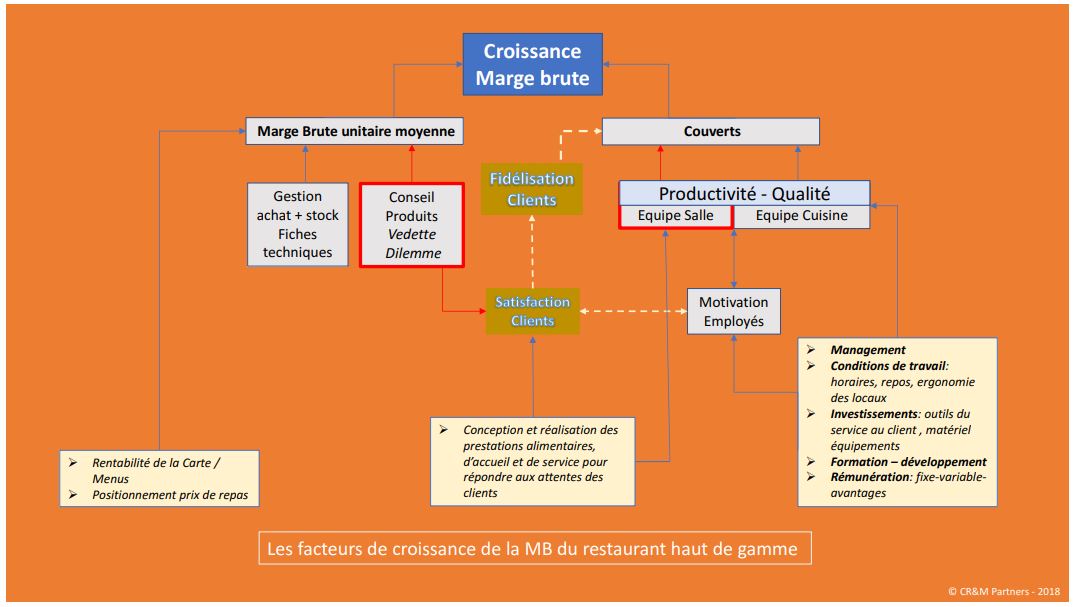
The ways to increase gross margin and value added need to be tailored to the restaurant owner’s strategic direction: external or franchise-based growth, organic growth, a move into fine dining and the pursuit of a star, lower prices or cost leadership in the local market, staff retention, preparing for the sale or handover of the business, restoring net margins, and so on.
Focus on the sales performance of your front-of-house team
Front of house, your team is made up of a Restaurant Manager, a Head Waiter, several waiters, a chef de rang, commis waiters, an apprentice, a sommelier, a bartender and perhaps a host or hostess, a cloakroom attendant or someone keeping the communal areas clean throughout service.
Beyond the qualitative criteria of your mystery diner survey, which scrutinise the welcome, professional skills and atmosphere, ask yourself how much room for improvement they have in terms of sales performance:
- Knowledge of customers and their needs, and personalisation of the relationship;
- Command of advisory and suggestive selling techniques;
- Handling of difficult customers (will they come back?);
- Handling of dissatisfied guests (will they drive away potential customers in a snowball effect?);
- Knowledge of the gross margin in euros on every item on the set menu and the à la carte menu;
- Team solidarity during the rush, and feedback of information;
- Knowledge of the restaurant’s sales targets and those of their station (gross margin, table turnover or number of customers per day, average spend, share of revenue and of gross margin from drinks);
- Degree of commitment to achieving the team’s targets.
Following this review, decisions and actions should be scheduled to address weaknesses or build on strengths: internal organisation, refresher training, coaching, tools for monitoring and rewarding sales performance, and a “consultative selling” section in the pre-service briefing.
Cast more as connoisseurs than as salespeople, waiting staff are, or can be, trained to make well-judged suggestions that enrich the customer’s dining experience. These should push up gross margin rather than the average bill, by focusing on the most popular high-margin dishes or wines and on those that are less attractive but among the most profitable.
If staff report good acceptance and satisfaction rates from customers for the former, a price increase can be considered. If they report customers’ objections to the latter, it will be easier to remedy their lack of success.
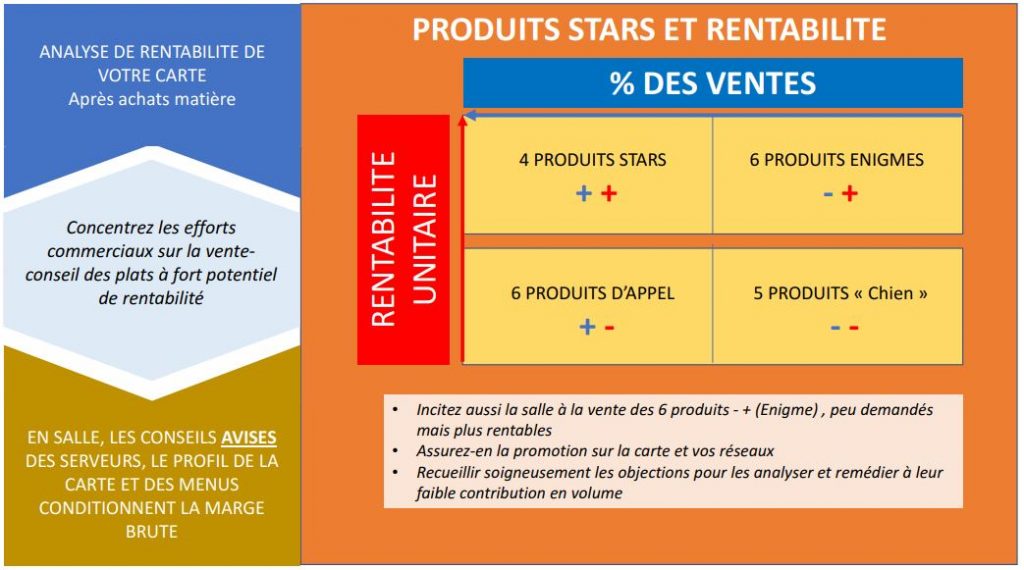
In contrast to the order-taker approach, the waiter or sommelier who advises customers, without being pushy or excessive, plays a real part in strengthening your margin rate and achieving gross margin growth that outpaces revenue growth.
Price increase policy: better to simmer than to flambé or hold back
If a restaurant manager refrains from raising prices each year until forced to do so, he or she runs two risks:
- No longer being able to raise prices enough to offset rising food costs;
- Having to raise them too abruptly later on, with a negative impact on footfall.
The best course is generally to opt for gentle, regular price increases, which will minimise the perceived impact on the customer’s wallet. Rates of increase can be differentiated across menu items to keep loss-leader products attractive, promote less popular high-margin dishes or capitalise on demand for star products.
Achieving the GM target in your business plan through customer loyalty
The occupancy rate or table turnover ratio of a traditional restaurant is also decisive for its level of profitability, as long as there is unused capacity. The GM target in your 3- or 5-year business plan should ideally take account of your potential to increase footfall, aiming for a certain number of additional covers year by year. To achieve this, performance in welcome and service must make it possible to build loyalty among more customers, or more target customers. In this respect, establishments heavily dependent on tourism are at a disadvantage, as the months and quarters following the 2015 terrorist attacks in France showed.
Nevertheless, every restaurant can count on the benefits of better customer loyalty: 28 years ago, the article by Earl Sasser (Harvard Business School) and Bain & Company, “Zero Defections: Quality Comes to Services”, demonstrated the multiplier effect on profit growth of a 5% increase in the customer retention rate. No one has proved them wrong.
To achieve the loyalty target, it is advisable to give front-of-house staff a stake in its success, as with gross margin targets, and to monitor their performance regularly at briefings by sharing information on tip levels, immediate and follow-up satisfaction ratings, and the handling of unhappy or disappointed customers, and by recognising every instance of a customer’s second visit, which marks the start of a longer relationship: loyalty.
Improving the productivity of your kitchen brigade without compromising the quality of your food
Sizing your teams realistically, scheduling opening hours optimally and making the right investment choices in kitchen technology and equipment naturally all affect the productivity of your brigade. It also depends on the individual and collective performance of the men and women you employ, and therefore on their motivation to do quality work that meets your guests’ expectations and hygiene standards and is in line with the economic targets, which must therefore be defined: number of covers, average output per hour or per person, food GM, brigade payroll cost or hours paid, or average hourly cost.
Every hour of production or creative work put in by the Chef and the brigade can either contribute to growing gross margin, with an associated improvement target, or, on the contrary, hold it back if the target is ignored.
Progress will be easier, when the menu changes with the seasons, if the margin rate of a new menu item is higher than that of the item it replaces, but its share of sales is also part of the equation for success.
Experience shows that the quality of purchasing and stock management is also essential to achieving or maintaining a competitive food cost ratio (food purchases / food revenue), which is synonymous with profitability. Involving the cooks in a zero-waste production target, daily stocktaking, adjusting the frequency of orders and systematically checking deliveries often account for 1 to 2 points of margin.
A high-end traditional restaurant that manages its ingredients well will aim, depending on the produce used, for an average food cost ratio of 20% to 30% while still serving generous portions.
Managing the kitchen team’s performance with targets and indicators such as food gross margin per paid hour or the food cost ratio generally makes it possible to rebalance productivity and overall quality (on the plate and in management) and to give better recognition to the brigade’s contribution to the restaurant’s performance.
Conclusion
To restore profitability, acting on gross margin by mobilising both teams, front of house and kitchen, around performance targets suited to the owner’s business strategy is just as important as controlling overheads. Identifying your room for improvement in sales performance, customer loyalty, management quality and kitchen team productivity is the first step towards achieving this.
Join us in a few days for the third and final part of our recipe: “Seasoning pay”.