
In the restaurant trade, the concepts of prime cost and overheads (PC, OH) are frequently used. When advising the owner of a renowned establishment who is seeking to improve profitability, the concept of Value Added (VA) is also relevant.
In accounting terms, a restaurant’s Value Added, or VA, is:
- The share of revenue that remains after paying food and drink suppliers and the business’s external charges;
- Gross margin minus external charges, or ‘overheads’.
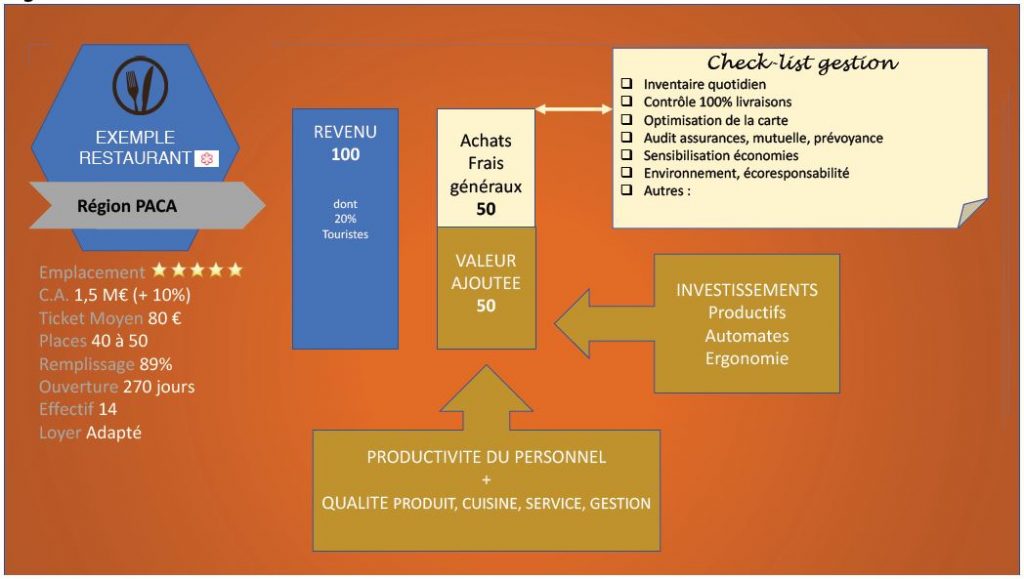
In financial terms, and in the eyes of a pay specialist, VA is also:
- The wealth created by your business
- The amount of money available to
- Pay salaries, social security contributions and taxes
- Generate gross operating profit.
To increase the VA and profit-making capacity of their restaurant, I advise Chefs and
Managers to try the following recipe for their spring–summer 2018 menu:
- Season pay
- Push up gross margin
- Flatten overheads
- Flattening overheads (OH) can add up to 5% to your profitability rate
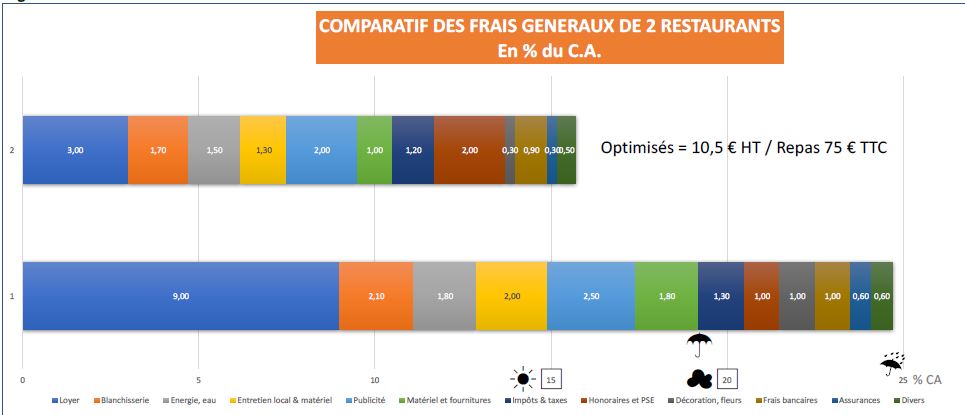
Overheads account for 15% to over 25% of turnover in high-end and Michelin-starred restaurants.
For an average customer spending €75, the share of overheads in what they ate and drank can be kept to €10–11 in a well-run restaurant. In that case, food and drink purchases can amount to 35% of turnover, or €30 per cover, a level compatible with a VA rate of 50% of turnover and satisfactory profitability.
On average in France in 2016, Michelin-starred establishments generated €1.4 million in turnover and €36,400 in profit. Flattening overheads by one point is equivalent to €14,000 of additional wealth.
The location myth
It is often said that a restaurant’s location is crucial to its success. Logically, rent is the largest overhead item, but it varies considerably in the upper traditional segment: from 3% of turnover with a good occupancy rate to 10% of turnover in a demand crisis or after a geographical or marketing positioning error.
For healthy profit-making capacity, it is better for rent to be below 5% of turnover. If it is close to 10%, looking for other premises better suited to your means, your market and your business is almost a condition of survival. In my view, adapting at every level is what is crucial in the business strategy of the independent owner of a Michelin-starred or high-end establishment.
Standing comes at a price
Laundry (tablecloths, napkins and uniforms) can account for almost one euro on a €50 meal: this is a variable cost that can be optimised through tendering or by making trade-offs.
Maintenance of your premises and equipment, together with cleaning products, represents 1.5% to 2.5% of the annual turnover of a quality traditional restaurant, and also depends on the quality of investment in these items. When investing in fitting out the kitchen, dining room or reception areas, you need to strike the right balance between ‘The price is forgotten, the quality remains’ and value for money.
While a Michelin-starred establishment may devote up to 1% of revenue to décor, flowers and plants, the ‘thrifty’ manager of a traditional restaurant will aim for a budget three or four times smaller for this fixed expense.
Allow just under one percent of sales for operating equipment and supplies, but more if you have opted for silverware, crystal, copperware and very fine porcelain.
Ask yourself, too, whether the cost of your valet parking service is compatible with your means and your needs, and how to optimise it or include it in your prices.
Surrounding yourself with the right advisers often generates recurring savings: fees and external service providers
The fees of your regular advisers and of the specialists you call on occasionally should be assessed in terms of the services rendered, the results and the savings achieved, particularly on overhead items (insurance, taxes and duties, bank charges) and on the social security contributions that fall within the definition of extended overheads. Using these specialists also has the advantage of taking up very little of the owner’s or Manager’s time, which accounts for part of their value:
- The various taxes and duties, which vary according to your location and structure, can be optimised by a specialist down to 1% to 1.25% of turnover – or cost 80% more.
- The relative cost of insurance covering your staff (health, death and disability, key person) and your premises (property and casualty) varies by a factor of 1 to 2 depending on the establishment and the contracts. With the end of designation clauses in the hotel, restaurant and café (HORECA) sector, an insurance audit by a broker operating a policy of systematic tendering will not be charged to you and is therefore likely to lighten your bill or improve your health and death and disability cover. Take the opportunity to optimise the cost of your property and casualty contracts.
- Even if you outsource your employees’ payroll, an audit of social security contributions and taxes will identify potential savings two times out of three, part of which – around 30–40% over a limited period – will pay for the specialist’s work.
Squeezing the expenses staff can influence
Water, energy, breakages, maintenance: while their cost is a matter for the Manager’s decisions, their consumption can be influenced by staff, who can be given a share in the savings through various forms of pay.
Limit advertising and promotion costs to 1% or 2% of turnover, depending on profitability
Restaurants need to communicate to attract new customers and work on their brand image, especially when times are hard. Making greater use of social and traditional networks is sometimes wiser than writing cheques for an advertisement or a promotional campaign. For example, if you are targeting business customers, the presence of the Chef and Manager on a site such as LinkedIn strengthens both their image and their network of potential customers. Meeting decision-makers in your region at the breakfast meetings of the CJD or BNI will cost you only a little time.
Conclusion
To restore profitability, focus on creating more wealth, and therefore more value added. Seeking savings across the dozen or so overhead items is an essential step and one of the golden rules of the most profitable establishments. Taking this route requires devoting time to it and surrounding yourself with competent specialists, but it is well worth it, and recurring savings have an almost immediate impact on cash flow.
See you in a few days for the second part of our recipe: ‘Push up Gross Margin’.