
The project stakeholders
The CEO who decides to change the company’s pay policy may be motivated by the wish to gain a strategic competitive advantage or to strengthen the company’s long-term sustainability. Their involvement in the project should be strong during the design phase, to set out the principles and strategic development objectives that the future pay policy will underpin and support.
Those leading the change project are most often the HR Director, the Compensation and Benefits team and certain managers, who will seek outside advice or the support of internal allies – the IT department or the CFO, for example – to design and implement the change.
Employees are key stakeholders when a pay policy changes: the project’s success will depend on their buy-in. Taking their needs and opinions on the matter into account will make implementation easier.
Employee representatives will sometimes be consulted and sometimes involved in the pay change project, depending on the quality of industrial relations.
Managers’ support is generally essential if the new pay rules are to be properly applied and communicated.
What exactly should you change?
Start by drawing up a list of the changes to be made to your pay policy, so that you can see your predetermined objectives clearly:
- Clarify the principles of your pay policy, so that they are consistent with your cultural values – based, for example, on teamwork and excellence.
- Improve alignment with the company’s strategic objectives in order to support growth or profitability.
- Change the fixed–variable pay structure in an uncertain environment for better cost control.
- Improve your competitive positioning for certain types of job that are highly exposed to the risk of staff turnover, and lower it for those that are insufficiently exposed.
- Define new salary ranges, with a spread and overlap that reflect your objectives for length of service in a role or for the retention of your best people.
- Opt for a new split between individual and across-the-board pay increases.
- Change the criteria for pay increases to make clear what matters in the work.
- Make better use of a total reward approach, so that the full range of rewards is valued rather than salary alone.
- Outsource certain stages of the pay process: calculating and paying salaries, social security contributions or bonuses, individual total reward statements, training, HRIS…
Mapping your current situation
In management, as in orienteering, reaching your goal means not only knowing where you are heading, but above all establishing where you are before you set off.
“Mapping” your current pay policy involves reviewing its main thrusts or principles, as well as the components and specific features of your pay system. If you use a compensation consultant, this diagnostic stage will take the form of a rigorous analysis of the effectiveness (social, economic, financial and technical) of your forms of pay, placing them precisely on the map using a battery of indicators.
Based on the analysis of strengths and weaknesses, and of the risks and opportunities of change, the long-term objectives, content and broad scenarios for the change will then be defined together with the company.
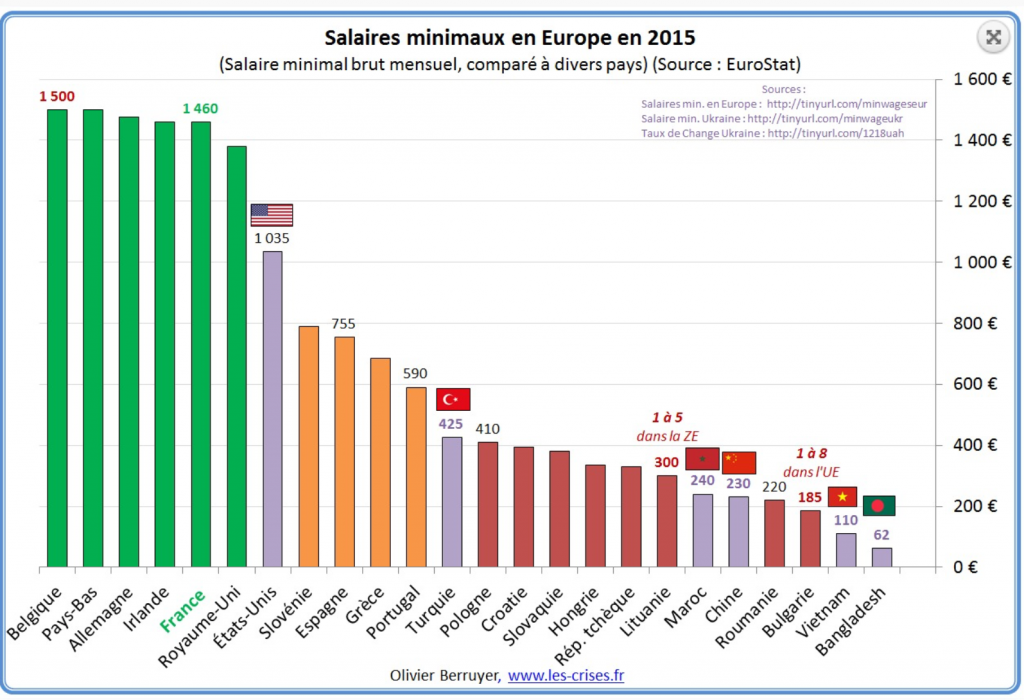
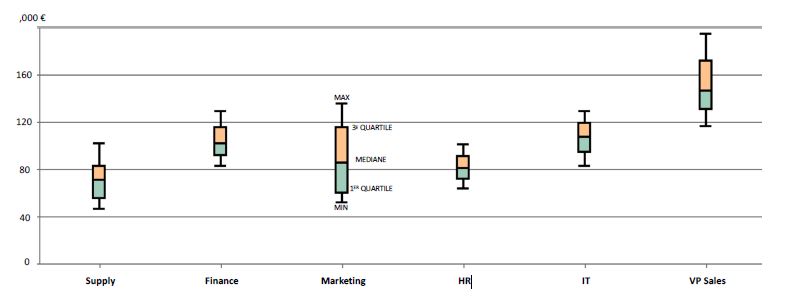
Market salary scale: Managers (Europe Survey)
Planning
A change of pay policy cannot be decreed with retroactive or immediate effect; it must be planned, step by step, like any other project that is essential to the company.
The design phase often takes place a year before roll-out. In this initial phase, the steps preceding a change of pay policy generally include job evaluation and job classification, which will establish the framework used to build the future salary structure.
The implementation phase centres on communication, the division of roles between HR and managers, and the procedures needed for correct application. Depending on the scale of the project, the designers will need to take resistance to change into account:
- How much effort will be needed to sell the change?
- How can stakeholders’ agreement be secured?
- When should cases of disagreement be dealt with?
- How can the learning curve for the new procedures be shortened for the hundreds of managers who will play a greater role in pay decisions in future?
As a policy commits the company – and you – over the long term, the change should produce measurable effects over time rather than in the short term.
How to organise the change
1 – Define the principles of your pay policy: to give your employees sufficiently clear directional markers, define your principles in terms of:
- Degree of transparency
- Priority given to the collective or to the individual
- Focus on skills and/or performance
- Short-term vs long-term horizon
- Pursuit of internal and/or external equity.
2 – Benchmark salaries to adjust your rules on internal equity and external competitive positioning.
3 – Set the new salary ranges or scales
- Start from the midpoint, which reflects on the one hand the salary of an employee whose contribution meets the requirements of the role and, on the other, the pay gap relative to the median (or another quartile) of the external market.
- The longer the target length of service in a given role, the wider the range should be. Generally, the range spread, which can vary from 10% to 80%, increases with the level of responsibility of the job or job grade.
- Check that the resulting salary structure is consistent with your objectives for differentials between grades, range penetration and range overlap.
- Identify employees who fall outside the scale in order to calculate the cost of bringing their pay into line.
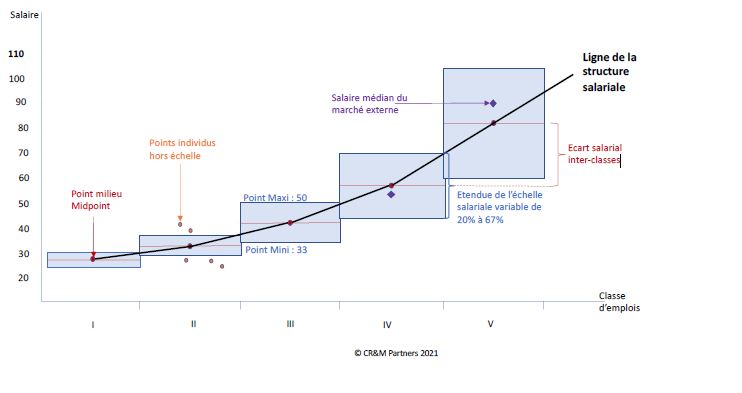
4 – Model the financial impact of the new salary structure to check that it remains within the company’s ability to pay.
5 – Set the specific pay rules that will apply in the event of recruitment, progression, promotion, transfer, creation or removal of a post or job, or positioning above the scale (for example, no increase, or possibly a one-off lump-sum payment).
Create or develop the tools needed to handle the most frequent cases and rules:
- Pay increase matrix and budget simulator
- Main criteria used to justify an employee’s pay progression; impact of absenteeism
- Guidance notes, scatter plots, etc.
6 – Define how the salary structure will be adjusted: creation of a job or job grade, or a change in its value; review of competitive positioning at least every two years, etc.
7 – Prepare for implementation
Quantifying
Within overall pay expenditure, the pay increase budget will depend on several factors:
- Future ability to pay, resulting from the extent to which revenue, management and profitability targets are achieved;
- The inflation rate;
- Pay trends in the sector and the desired competitive positioning for the various jobs.
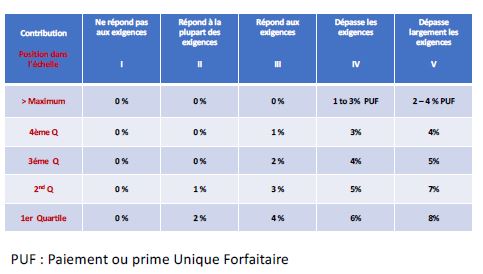
With a standard pay increase matrix, increase rates will depend on the contribution assessed by the manager and on the employee’s current position within a given quartile of the salary range for the job held.
To keep within a strict budget, the matrix rates can be modelled on the basis of managers’ contribution assessments for all employees.
Pay increase matrix
Why change your pay policy?
A pay policy based on a connected salary structure limits the freedom of action of managers and HR administrators, and is therefore considered as a way to improve:
Control of payroll costs: decisions framed by guidance notes, adherence to budget, automated data processing, decision-support tools.
- Internal equity: fewer arbitrary decisions, clearer award criteria, adherence to the internal D9/D1 pay ratio (9th decile / 1st decile), with a view to securing greater buy-in to the pay policy.
- External equity: in a growth phase, attracting and retaining the best people requires a market-leading pay offer, above market rates, for all the key jobs in the company’s strategic plan.
- Staff productivity: deciding between doing in-house and outsourcing (benchmarking, individual total reward statements, tools), raising individual contribution, tackling the dysfunctions that generate hidden costs. An effective pay policy will act on uncontrolled staff turnover, lack of motivation, absenteeism, poor quality, conflict and processing times, and will therefore turn more work into value added for the company.